
Time Management for Students: A Practical Guide
"I just don't have enough time" is the most common complaint among students — and it is almost never true. What students lack is not time but a system for using it. Between classes, assignments, exams, family obligations, and the bottomless pull of the phone, the day evaporates. This guide gives you a realistic, step-by-step system to take control of your time without turning your life into a military schedule.
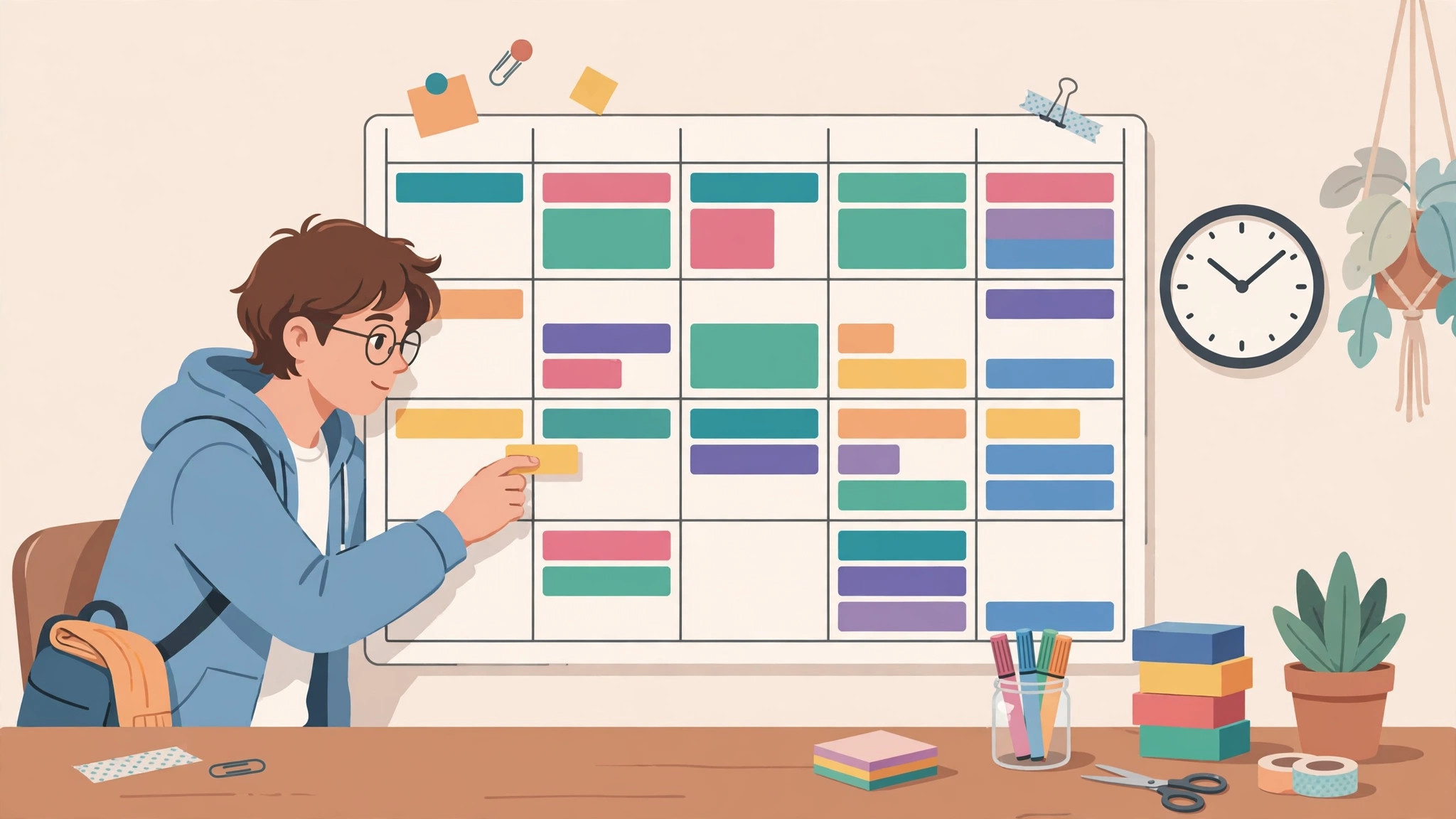
Step 1: Audit Where Your Time Actually Goes
You cannot manage what you do not measure. For three days, jot down what you do each hour — classes, studying, phone, TV, chatting, sleeping. Most students discover two to three "lost" hours daily, usually on the phone. This is not about guilt; it is about finding the raw material you will redirect.
Step 2: Build a Weekly Template
Instead of planning each day from scratch, create a repeating weekly template:
- Block fixed commitments first: classes, prayer times, meals, sleep, commute.
- Assign study blocks to the gaps — aim for 25–50 minute focused sessions with short breaks.
- Leave one completely free evening per week and buffer time between blocks; rigid plans shatter on contact with real life.
- Put exam dates and assignment deadlines on a wall calendar where you see them daily.
Step 3: Prioritise with the Eisenhower Matrix
Not all tasks deserve equal time. Sort your to-do list into four boxes:
- Urgent + Important: tomorrow's exam, assignment due tonight — do first.
- Not Urgent + Important: weekly revision, learning a skill — schedule it, or it never happens.
- Urgent + Not Important: some messages, minor errands — delegate or batch.
- Neither: endless scrolling — eliminate or strictly limit.
Students typically live in box one and four, and neglect box two — yet box two is where grades are actually built.
Step 4: Use Time Blocking
Assign every study block a specific job: "Monday 7–8pm: Chemistry chapter 4 practice questions." Vague blocks ("study in the evening") invite drift. When the block ends, stop — this trains your brain to focus intensely because the finish line is visible.
Step 5: The Two-Minute Rule
If a task takes less than two minutes — replying to a teacher's message, filing notes, writing tomorrow's top three tasks — do it immediately. Small tasks pile into mental clutter when postponed.
Step 6: Beat Procrastination at Its Root
Procrastination is usually not laziness; it is avoidance of unpleasant feelings — boredom, confusion, fear of failure. Counter it with:
- The 5-minute start: commit to just five minutes. Starting is the hardest part; momentum usually carries you forward.
- Temptation bundling: pair a boring task with something pleasant, like reviewing flashcards while having your favourite tea.
- Environment design: phone in another room during study blocks. Willpower is unreliable; distance is not.
- Breaking it down: "write the assignment" is paralysing; "write the introduction paragraph" is doable.
Step 7: Protect Your Sleep
Cutting sleep to study is a false economy. Sleep consolidates memory — an all-nighter literally prevents your brain from storing what you studied. Aim for 7–8 hours, keep a consistent wake time, and avoid screens for the last 30 minutes before bed.
Step 8: Review Weekly, Not Just Daily
Spend 20 minutes every Sunday reviewing: what got done, what slipped, and why. Adjust next week's template. This feedback loop is what turns a plan into a habit — without it, even the best system decays within weeks.
Common Traps to Avoid
- Over-scheduling: planning every minute leaves no room for life. Keep 20% of your time unscheduled.
- Multitasking: switching between WhatsApp and studying can cost up to 40% of productive time. Single-task.
- Perfectionism: a decent study session done beats a perfect one postponed.
- Comparing schedules: your classmate's 6-hour marathon may be mostly phone breaks. Run your own system.
Managing Energy, Not Just Hours
Time management fails when it ignores energy. You have roughly 3–4 hours of peak mental sharpness daily — usually in the morning for most people. Spend those hours on your hardest subject and relegate easy revision, organising notes, and admin to low-energy slots. Two practical rules: never schedule demanding study right after a heavy meal, and protect one full rest day per week — chronic overwork produces the illusion of studying while retention quietly collapses. Track your energy for a week (rate focus 1–10 each study block) and you will see your personal pattern clearly.
Digital Minimalism for Students
Your phone is not just a distraction; it is a dozen distractions wearing one disguise. A realistic declutter, not digital monkhood:
- Delete or bury the worst offenders for the semester — you can reinstall them in the holidays. If that feels impossible, that is precisely the sign you need to.
- Turn off all non-human notifications. Keep calls and messages from real people; kill everything from apps (likes, streaks, "we miss you").
- Make the phone boring: grayscale mode, no social apps on the home screen, and a 15-second delay shortcut before opening anything addictive.
- Batch your checking to three fixed windows daily (e.g., lunch, evening, night) instead of 80 micro-checks. Inform close friends so nobody panics.
Students who do this typically reclaim 1–2 hours daily within the first week — the single highest-ROI time management move available.
Sample Daily Schedule (College Student)
- 6:30–7:00 — wake, breakfast, review today's top 3 tasks
- 7:00–9:00 — deep study block 1 (hardest subject), phone in another room
- 9:00–1:00 — classes
- 2:00–3:30 — deep study block 2 (second subject)
- 4:00–5:00 — assignments, easy revision, admin
- 5:00–7:00 — free time, exercise, family
- 8:00–9:00 — light review: flashcards, error notebook, plan tomorrow
- 10:30 — sleep (non-negotiable)
Adapt the skeleton to your class timings — the principles (deep work early, phone discipline, protected sleep) matter more than the exact hours.
The Sunday Reset Ritual
Fifteen minutes every Sunday evening prevents the slow decay that kills most timetables. The ritual has four steps: (1) glance at last week's plan and mark what actually happened — no judgment, just data; (2) carry unfinished important tasks into next week rather than letting them vanish; (3) block next week's study sessions into the calendar around fixed commitments; (4) pick one focus upgrade for the week (phone further away, mornings for maths, etc.). Write it in the same notebook each week so you can flip back and see months of compounding improvements. Students who run this ritual keep their systems alive all semester; those who do not usually abandon planning by week three.
Frequently Asked Questions
How do I balance studies with a part-time job or family duties?
Be ruthless about the audit step — find your real free hours first. Then protect study blocks like appointments, communicate your schedule to family, and use micro-sessions (15–20 minutes) for revision on busy days.
What if I keep failing to follow my timetable?
Your timetable is probably too ambitious. Halve it. A plan you follow at 90% beats a perfect plan you follow at 30%. Build up gradually.
Are productivity apps necessary?
No. A paper notebook and a wall calendar beat a fancy app you never open. Use digital tools only if you genuinely enjoy them.
How much study time is enough?
It depends on your goals and level, but 2–4 focused hours daily is plenty for most school and college students when the time is truly focused.
Seekho Learn Editorial Team — practical guides for students and young professionals.